
Why Motion Activated Lighting Is One of the Smartest Ways to Protect Your Maryland Home
How motion activated lighting deters intruders comes down to one simple idea: burglars want easy, unnoticed access — and a sudden burst of light destroys that. When a motion-activated light fires on, it signals to a would-be intruder that they’ve been noticed. That single moment of uncertainty is often enough to make them walk away.
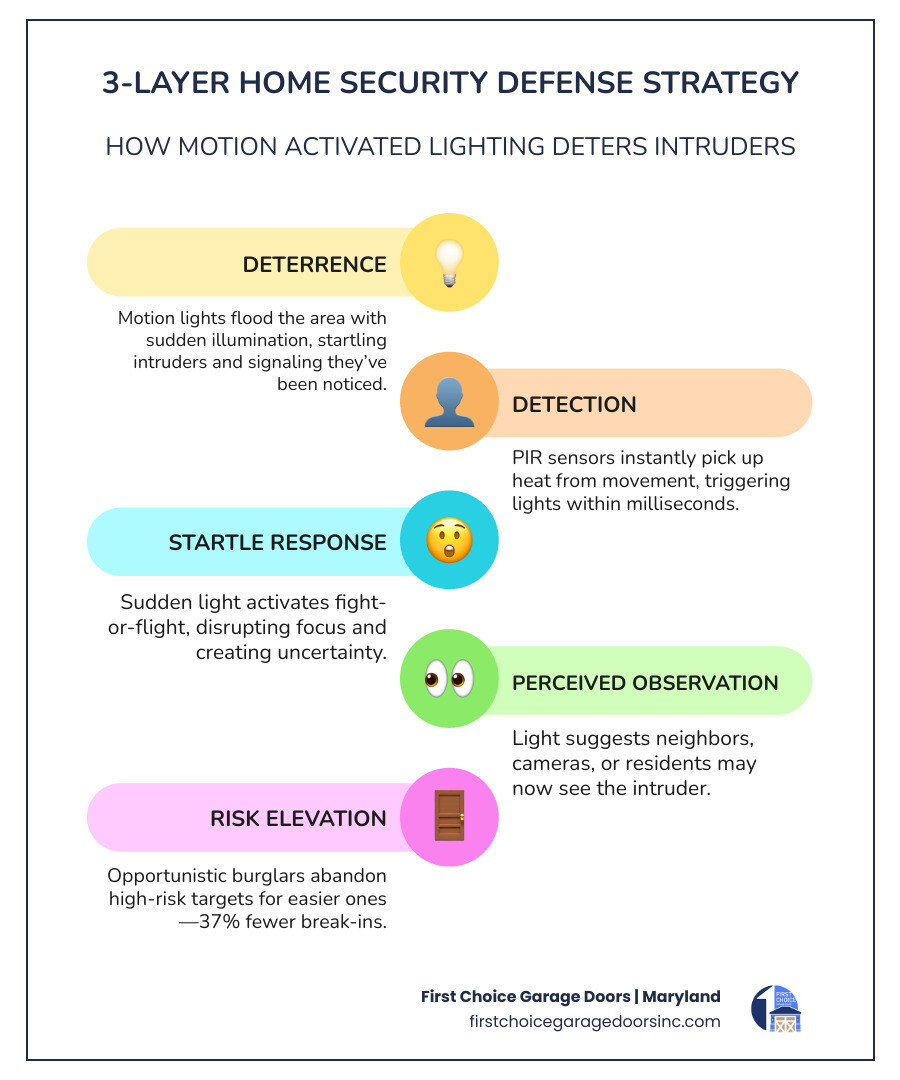
Here’s a quick breakdown of how it works:
- Detects movement – A sensor (usually passive infrared, or PIR) picks up heat from a moving body
- Triggers instant illumination – The area floods with light within milliseconds
- Creates a startle response – The sudden change disrupts the intruder’s focus and triggers their fight-or-flight instinct
- Signals possible observation – Neighbors, cameras, or residents inside may now see them
- Raises the risk of getting caught – Most opportunistic burglars will simply move on to an easier target
This matters more than most homeowners realize. One burglary happens every 22.6 seconds in the U.S., and the majority are committed by casual, opportunistic offenders — not hardened professionals. These are people looking for a quick, low-risk grab. A well-placed motion light changes the risk calculation fast.
Research backs this up. A 2022 study published in the Journal of Experimental Criminology found that homes using motion-activated exterior lighting saw a 37% reduction in attempted break-ins compared to similar homes using only static lighting. Separately, about 60% of convicted burglars reported they would avoid properties with visible security lighting altogether.
For Maryland homeowners — especially those with attached garages, which are among the most common entry points for burglars — motion-activated lighting is not just a nice-to-have. It’s a practical first line of defense.
Understanding How Motion Activated Lighting Deters Intruders
To understand how motion activated lighting deters intruders, we first have to look at the technology inside the fixture. Most modern security lights use Passive Infrared (PIR) sensors. These sensors don’t “see” images like a camera; instead, they detect heat signatures. When a warm body—like a person or a large animal—moves across the sensor’s field of view, it detects a rapid change in infrared radiation and completes the circuit to turn on the light.
In our experience at First Choice Garage Doors, we’ve seen that many Maryland homeowners overlook the garage as a primary security vulnerability. However, why garage door lighting is a great feature to have goes beyond just seeing your keys at night. It creates “behavioral unpredictability.” While a static porch light that stays on all night eventually becomes part of the background, a light that flares to life only when someone approaches creates a dynamic event that demands attention.
The effectiveness of this technology is backed by real-world data. Beyond the 37% reduction in break-ins noted in the 2022 Journal of Experimental Criminology study, neighborhoods that embraced widespread outdoor security lighting saw overall crime rates drop by about 20%. When these lights are synergized with cameras, the drop in attempted break-ins can reach a remarkable 70%.
The Science Behind How Motion Activated Lighting Deters Intruders
The deterrent effect isn’t just about visibility; it’s about psychology. Humans (and intruders) have what is known as an “orienting response” or a “pop-out effect.” Our brains are hardwired to direct attention toward sudden novelty or change in our environment. When a light snaps on, it triggers a “fight-or-flight” response.
As Dr. Lena Torres, a Behavioral Criminologist, explains, the most effective deterrents interrupt the offender’s “decision calculus.” A motion light makes an intruder stop and ask, “What just noticed me?” Static lights don’t ask questions; they just provide a constant, predictable environment where a burglar can plan their shadows. By forcing an intruder to wonder if a resident just flipped a switch or if a smart system is alerting the authorities, you disrupt their “script” and increase their perceived risk of capture.
Deterring the Casual Offender
It is a common misconception that most burglars are masterminds. In reality, 8 out of 10 residential burglaries are committed by casual, low-skill offenders. These individuals live for the path of least resistance. They often live within two miles of the target and spend an average of only 58 seconds observing a property before deciding to strike.
By removing the cover of darkness, motion-activated lights strip away the intruder’s greatest asset: anonymity. When a light activates, it creates a “perceived presence.” Even if you aren’t home, the light suggests that the house is active and “aware.” This, combined with other occupancy cues like timed interior lights, makes your home a much less attractive target for an opportunist looking for a quick win.
Strategic Placement for Maximum Security in Maryland

Simply buying a light isn’t enough; you have to put it where it counts. For Maryland homes, the garage is often the “soft underbelly” of home security. We recommend following 4 garage security tips to harden this entry point, with lighting being a top priority.
Strategic placement involves identifying “blind spots” where an intruder might crouch or hide. The goal is to mount sensors at a height that maximizes their range while preventing tampering. We generally recommend an elevation of 6 to 10 feet. If a light is too low, an intruder can easily unscrew the bulb or mask the sensor. If it’s too high, the sensor may fail to pick up heat signatures at ground level.
Optimizing How Motion Activated Lighting Deters Intruders Near Garages
When we perform garage door security audits in Columbia or Frederick, we focus heavily on the driveway and the garage perimeter. The ideal setup includes mounting lights under the eaves of the house or garage. This protects the fixtures from our Maryland weather—from humid summers to icy winters—while providing a wide, downward-casting field of light.
You want the light to cast across the threshold of the door. This ensures that the moment an intruder steps toward the handle or the garage door tracks, they are bathed in light. Neutralizing these hiding spots is key to making your home look “difficult” to a prowler.
Coverage and Sensitivity Calibration
Most high-quality security lights offer a 180-degree detection angle, but some specialized models provide up to 270 or even 360 degrees of coverage. For the best results, use an overlapping field strategy. If you have two lights, position them so their detection zones cross. This eliminates “dead zones” where an intruder could sneak through.
Calibration is also vital. You don’t want a passing squirrel or a swaying tree branch in Easton to trigger your lights all night—this leads to “alarm fatigue” for you and your neighbors. Most modern units have “pet-friendly” settings or adjustable sensitivity dials. We suggest setting these to a medium level and tilting the sensor slightly downward to focus on human-sized movement rather than street traffic or small animals.
Key Features to Look for in Security Lighting
When selecting your lighting, don’t just grab the cheapest option off the shelf. Look for quality indicators that ensure the light will actually work when you need it most.
| Feature | Why It Matters | Recommendation |
|---|---|---|
| Power Source | Reliability vs. Ease of Install | Hardwired is best for security; Solar for remote areas. |
| Bulb Type | Brightness and Lifespan | LED (5000K-6500K “Daylight” white). |
| Sensor Tech | Accuracy of Detection | Passive Infrared (PIR) for heat detection. |
| Adjustability | Customizing the Range | Look for adjustable timers and sensitivity. |
| Warranty | Build Quality | 10-15 year warranties indicate professional grade. |
Modern smart garage door openers often come with integrated lighting features, but for exterior security, LED technology is king. LEDs are energy-efficient, last up to 25 years, and provide an intense, “startle-worthy” brightness that old incandescent bulbs can’t match. Also, look for aluminum ballistic housing rather than cheap plastic to ensure the unit can withstand the elements and potential vandalism.
Integrating Lighting with Your Total Home Security Plan
Lighting is your first layer of defense, but it works best when part of a security ecosystem. In the security industry, we call this the “onion” approach—creating multiple layers of resistance.
A powerful combination is synchronizing your motion lights with your cameras. When the light detects movement, it can trigger your camera to start recording and send a real-time alert to your phone. This is why your home needs a wifi garage door opener; many modern smart openers can link with your home’s smart hub (like Alexa, Google Home, or specialized security apps) to create a coordinated response. Imagine the light turning on, your phone buzzing, and your interior hallway lights flickering simultaneously—that level of “awareness” is a nightmare for an intruder.
Frequently Asked Questions about Motion Security Lights
We hear a lot of questions from Maryland homeowners about whether these systems are worth the effort. Here are the most common concerns we address during our service calls in Baltimore and Annapolis.
Do motion lights attract burglars by revealing entry points?
This is a common myth. The truth is that burglars already know where your doors and windows are. What they don’t know is if they are being watched. Motion lights elevate the “discovery cost.” Research shows that intruders interpret unexpected light as a signal of observation. In fact, in some studies, nearly 60% of apprehended suspects reported they abandoned their attempts because they “felt watched” once the light activated.
Are solar-powered motion lights effective in Maryland winters?
Solar lights have come a long way, but they can struggle during Maryland’s short, overcast winter days. Standard budget solar units can lose 40-60% of their battery capacity when temperatures drop below freezing. If you go solar, look for professional-grade models with monocrystalline panels and lithium-iron-phosphate (LiFePO4) batteries rated for -20°C. For critical security zones like your main garage door, we always recommend a hardwired backup.
Can I add motion sensors to my existing garage lights?
Yes, you can! There are retrofit adapters that screw into existing sockets, though these often lack the fine-tuned sensitivity adjustments of dedicated fixtures. For the highest reliability, we recommend replacing the fixture with an integrated motion unit or installing a separate hardwired wall-mounted sensor that controls your existing lights. This ensures a cleaner look and better performance.
Conclusion
Securing your home is about more than just a strong lock; it’s about creating an environment where an intruder feels exposed and unwelcome. How motion activated lighting deters intruders is by exploiting their fear of being seen and disrupting their plans with high-tech, responsive illumination.
At First Choice Garage Doors, we’ve spent years helping Maryland residents in Columbia, Easton, Frederick, and beyond secure their homes. Whether you need a Secure View Ultra Quiet Belt Drive Smart Opener with Camera, LED Corner to Corner Lighting and Battery Backup or a Secure View Ultra Quiet Belt Drive Smart Opener with Camera and Dual LED Lighting, we have the expertise to ensure your garage is a fortress, not a target.
Don’t wait for a “close call” to think about your home’s safety. Contact us today for professional installation and expert advice on making your property the brightest—and safest—on the block. Our team of experienced professionals is ready to provide the quality and prompt service you deserve.
Ready to upgrade your garage security? Contact First Choice Garage Doors today for a free estimate and let us help you find the bright way to keep intruders away!